


Innovation Director
As one of Numiko's founders, Jaron leads our innovation practice, exploring what new technology can do for the organisations we work with.
‘Collection dreaming’ for the National Gallery
‘Collection dreaming’ for the National Gallery

Written by Jaron Ghani, Innovation Director
AI —
Jump to content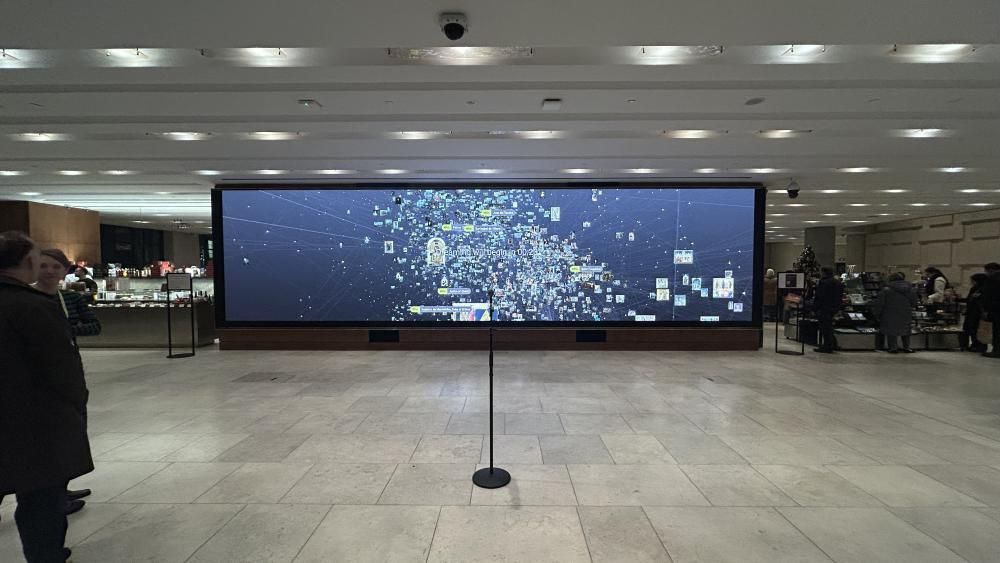
Experimenting with new ways to interactively explore digital collections
What if the National Gallery could dream? What connections would it make between paintings, what patterns would it see, what unexpected journeys might it chart through centuries of art?
These questions sparked the National Gallery Dreaming project, a collaboration between Numiko and the National Gallery's NGX innovation programme. Launched at the Gallery's Digital Takeover Late on 12 December 2025, the installation transformed the newly reopened Sainsbury Wing's spectacular 10x3m screen into a living, breathing exploration of one of the world's finest art collections.
Traditional collection interfaces present artworks in predictable ways: by artist, period, medium, or subject. They're logical, structured, and great if you know what you’re looking for - but they don’t always encourage serendipity.
Dreaming takes a different approach, using AI and computer vision to reveal the hidden relationships and unexpected connections that exist within the collection's rich web of information.
The experience creates a dream-like journey through approximately 2,400 works from the National Gallery's collection, drawing associations between paintings from both their compositions as well as the relationships from their textual metadata. It's playful and intuitive, designed not just to inform but to inspire curiosity and surprise.
At its heart, Dreaming is built on a sophisticated AI analysis pipeline that processes each artwork and its record across multiple dimensions. It detects content features including faces, objects, and shapes. And it integrates the Gallery's existing rich metadata, covering everything from artist and school to historical context and provenance. It also extracts and identifies ‘named entities’, like people, places and even abstract concepts. This is possible because of the Gallery’s incredibly rich and well-crafted object records which have recently been made available as open data.
This multi-dimensional analysis creates what's known as a knowledge graph, a dense network of relationships connecting approximately 2,400 nodes representing artworks, artists, concepts, and entities. Think of it as a map of the collection where proximity indicates similarity or connection, whether that's visual resemblance, shared subject matter, chronological links, or stylistic connections.
We then used 3D web technologies to render this data as a ‘force-directed graph’, to self-organise its display in a 3D space - and to bring to life the relationships and connections in an intuitively spatial way. The journey generation system then navigates through this knowledge graph, using shared node connections to find related works.
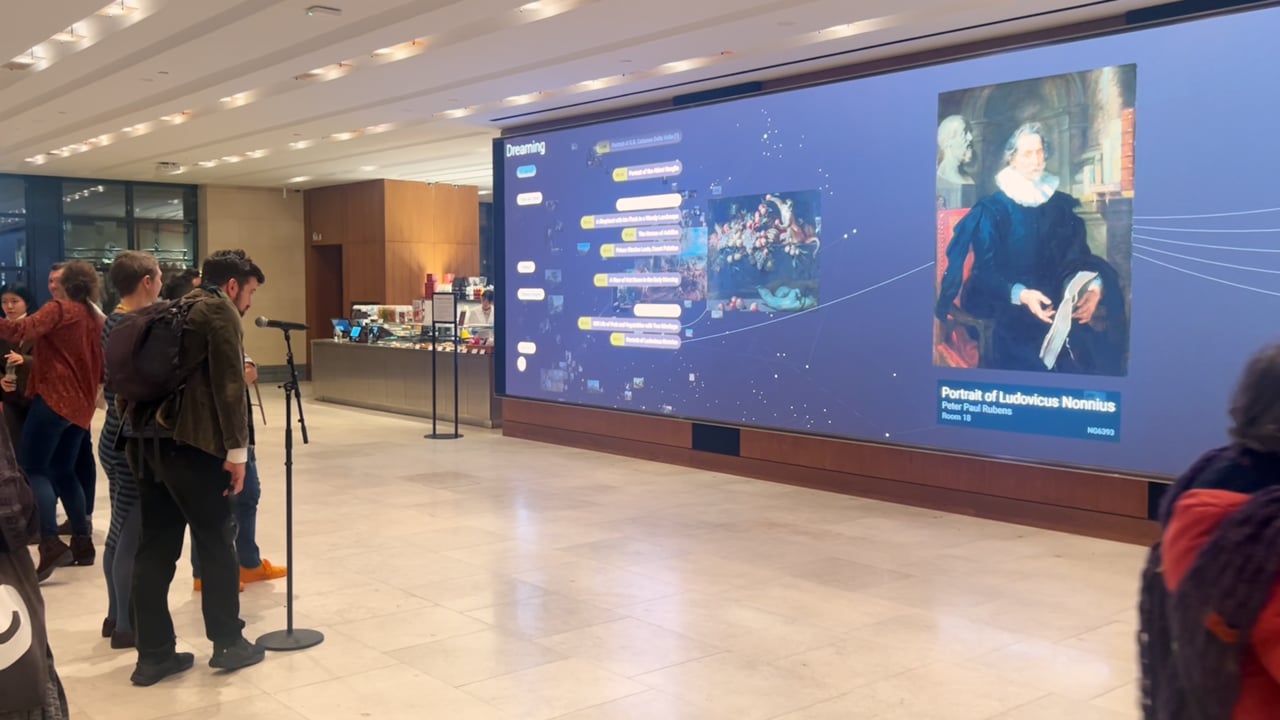
The experience takes its own path if left to its own devices, but we wanted to make the most of the site-specific opportunities for interaction, afforded by the amazing space in the Sainsbury Wing foyer. We let visitors influence the journey by speaking into the microphone - say "faces" and it might explore portraiture across centuries. Mention "baroque" and watch it traverse works united by genre.
One of the project's most distinctive features is its transparency. Rather than presenting AI as a mysterious black box, Dreaming deliberately shows its working. ‘Chat messages’ explain what the system is thinking about, what connections it's making, and why it's choosing to move from one work to another. Visitors need to see the "proof of life" in the system's intelligence, to understand the logic underpinning each transition.
The installation presents distinct viewing modes that transition seamlessly between each other - we show individual artworks in intimate detail, to showcase both the high-resolution screen and the Gallery's exceptional image assets, alongside its connections with other works, concepts, and entities. Periodically, the camera pulls back to show the entire collection's ‘dream cloud’, visualising the overall structure and relationships being explored.
The project yielded several important insights for cultural institutions exploring AI applications. First, transparency enhances rather than diminishes the experience. Showing the AI's decision-making process helps visitors understand and trust what they're seeing, turning what could feel like technological wizardry into a more organic and conversational experience.
Second, AI works best when it augments rather than replaces human expertise. The system uses the Gallery's existing metadata as a foundation, based on object records that have been carefully created by curatorial experts over many years. The AI reveals new connections and patterns within this curated knowledge, but it doesn't attempt to supplant the expertise that created it.
Third, rapid prototyping and experimentation are possible in institutional contexts. The compressed timeline from September to December demonstrated that innovation can move quickly when teams have the right combination of technical capability, institutional support, and willingness to iterate.
The technical infrastructure built for Dreaming provides a foundation for future AI-driven interpretative projects, both at the National Gallery and potentially as a template for other museum installations. We’re already talking about ways to make the experience available more regularly; it’s got huge value both as public engagement tool and a showcase for innovative uses of the collection. Watch this space for news of future opportunities to experience the installation - or get in touch. We’d love to show it to you in action.
For the wider cultural sector, Dreaming demonstrates that AI can open new ways of engaging with collections without compromising institutional values or curatorial authority. It shows that playful, accessible interfaces can coexist with scholarly rigour, and that technology can reveal rather than obscure the rich relationships within cultural collections.
The project embodies what we at Numiko believe about digital innovation in the cultural sector: it should be user-centred, evidence-based, and genuinely accessible. It should respect and enhance existing expertise rather than attempting to replace it. And it should create experiences that inspire curiosity, spark discovery, and ultimately encourage people to engage more deeply with the collections themselves.
Innovation Director
As one of Numiko's founders, Jaron leads our innovation practice, exploring what new technology can do for the organisations we work with.