

Marketing Lead
With a passion for purpose-driven marketing, Rob leads our marketing team, shaping the strategy behind Numiko's growth.
How to shrink your website's carbon footprint
How to shrink your website's carbon footprint

Written by Rob Allen, Marketing Lead
UX & Design —
Jump to content
Your website has a carbon footprint, and it’s probably bigger than you think. We’re sharing practical steps to reduce it.
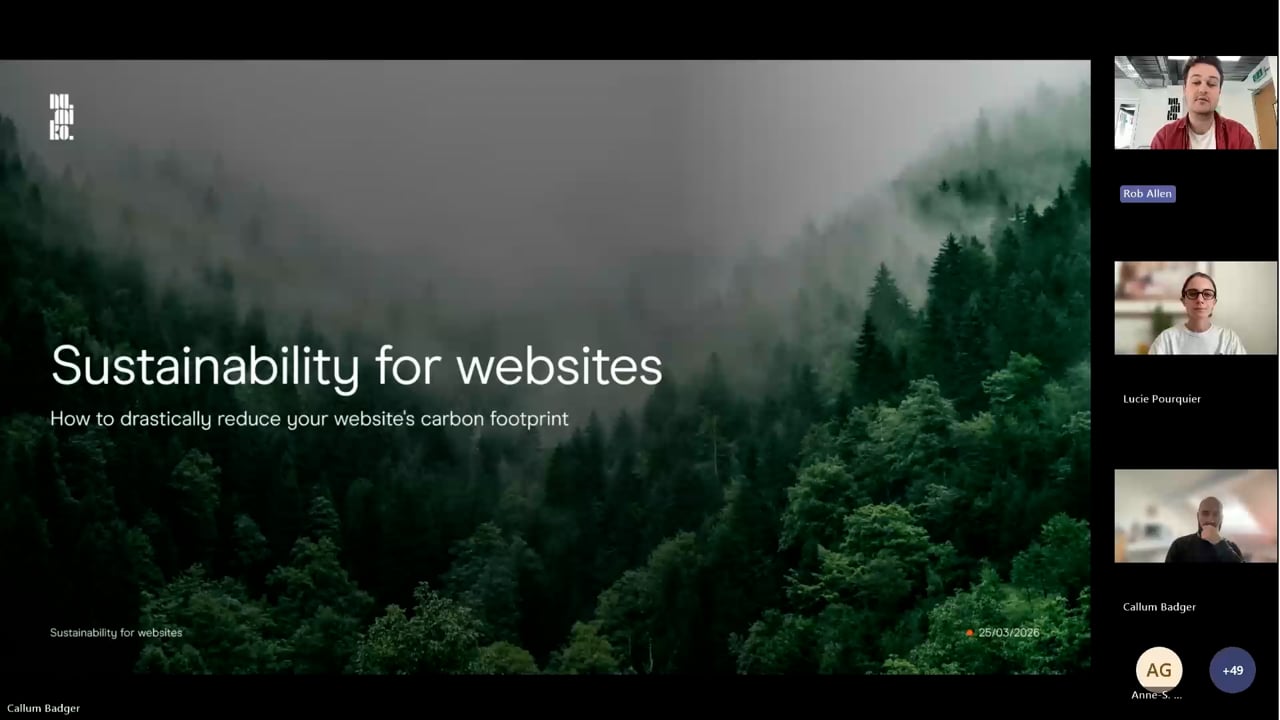
We recently hosted a webinar with Callum Badger, our Senior Designer, and Lucie Pourquier, Senior Sustainability Consultant at Upsun, to explore how organisations can reduce the carbon footprint of their websites. We had a brilliant turnout, with digital professionals from charities, universities, museums and public bodies joining the session. You can read our summary of the key takeaways here, or watch the full recording.
The internet accounts for around 4% of global CO2 emissions, equivalent to the entire aviation industry. If the internet were a country, it would rank as the 7th largest carbon emitter in the world.
For purpose-driven organisations, this matters. If you have a sustainability strategy, your website should be part of it. But there’s also a strong practical case: sustainable websites are faster, cheaper to run, perform better in search, and are more accessible. The things that cause bloat are often the same things that create barriers for users. Sustainability and quality point in the same direction, and it’s not a trade-off.
Every time someone loads a web page, energy is spent at every stage: the server that holds the data (15%), the network that carries it (14%), and the user’s device renders it (52%). That largest chunk means emissions aren’t just a hosting problem, they happen right in the browser, and design decisions directly affect this number.
An average web page produces between 0.5 and 1.76 grams of CO2 per page view. That sounds trivial but scale it up: a site with 150,000 monthly page views generates around 264kg of CO2 a year. If your ambition is to grow that traffic, the number only gets bigger.
Callum walked through the main factors that make a website ‘heavy’ in carbon terms. Images are the single biggest offender, accounting for nearly half of all data transferred. Using SVGs where possible, compressing images before they reach the CMS, and implementing lazy loading are all straightforward wins. Video, which makes up 65% of global internet traffic, should earn its place too. Ask whether it genuinely helps the user, rather than just looking good.
Fonts add up quickly. A single custom web font can be 250KB, and each weight adds roughly the same again. Prefer system fonts where possible, then web fonts, and only use custom fonts where the brand demands it. Even colour choices matter: darker colours use less energy to illuminate, and offering a dark mode option can reduce display energy on OLED screens considerably.
Perhaps the most important takeaway was that good user experience and sustainability are fundamentally aligned. A confusing website forces users to click around looking for what they need, and more clicks mean more page loads, more requests, more energy.
Content audits, often framed as editorial exercises, are also sustainability actions. Every redundant page you remove is one that no longer needs to be stored, crawled or served. Better SEO means users arrive at the right page faster, cutting wasted navigation.
Increasingly, your content also needs to work for a third audience beyond your team and your users: AI. Tools like ChatGPT and Perplexity crawl your website to answer questions about your organisation. Clear structure, plain language and well-organised content help these tools work more efficiently, and reduce energy consumption in the process.
Lucie introduced Upsun’s M.O.D.E framework for greener cloud operations: Measure, Optimise, Deploy, and Educate. The starting point is measurement: you need to understand where your emissions come from before you can reduce them. Upsun works with independent climate experts to calculate emissions from cloud infrastructure, going beyond the often opaque estimates from major cloud providers.
The most striking insight was around geolocation. The carbon intensity of electricity varies enormously by location. Hosting in Stockholm, which benefits from Sweden’s decarbonised grid, has a carbon intensity of just 26 gCO2e/kWh, compared to 717 for Sydney. Upsun shared a case study where migrating 15 projects from Ireland to Sweden delivered an average 88% reduction in yearly CO2 emissions. Numiko co-led a similar migration for the University of Oxford, which also delivered significant environmental gains. Alongside geolocation, techniques like rightsizing servers and pausing unused environments can deliver a further 2-4% annual reduction, and tend to save money too.
Callum’s parting message was a reassuring one: this isn’t about stripping your website back to a plain text page. It’s about being intentional. A bespoke illustration might use more data than a stock photo, but if it better conveys your mission, it earns its place.
You don’t need a full redesign to start making progress. A content audit, image compression, and a conversation with your hosting provider are all things you can act on now. If you are planning a redesign, even better. Sustainability can be built in from the ground up.
Our team can help at every stage. Whether you need a content strategy to cut through the clutter, an accessibility and performance review to benchmark where you are, or a digital brand and UX overhaul designed with sustainability in mind, we’d love to talk.
Get in touch and let’s make your digital estate leaner, faster, and greener.
Marketing Lead
With a passion for purpose-driven marketing, Rob leads our marketing team, shaping the strategy behind Numiko's growth.