
Marketing Assistant
Rethinking how museums capture the knowledge they create every day.
Museums are constantly generating new knowledge. Every exhibition, research project and community workshop produces valuable information, from updated object locations to personal stories and newly written label text. The problem is that most of this knowledge never makes it back into the museum's official records. It sits in spreadsheets, Word documents and shared drives, and when a project ends, it’s effectively lost.
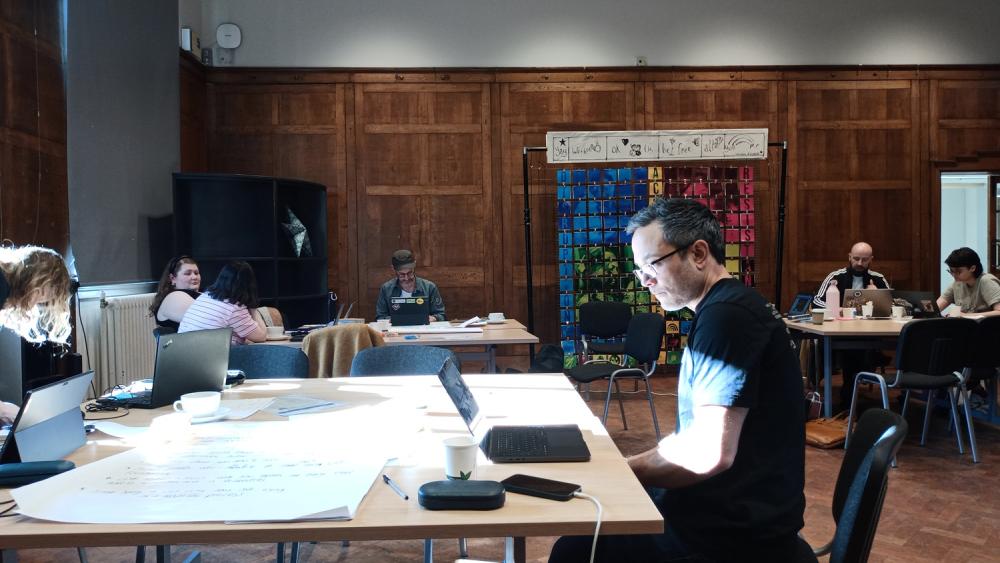
Collections Trust set out to address this with their first ever hackathon, held over two days at York Explore Library and Archive. The event brought together developers, designers and museum professionals to build working prototypes that could help museums better capture and share this knowledge. We were delighted to take part, with two Numiko team members, Callum Badger, Senior Designer, and Jaron Ghani, Innovation Director, each joining a different hackathon team to get stuck into real museum problems with real museum data.
North Lincolnshire Museum: where’s our stuff?
The team that took the top prize, which included Jaron, our Innovation Director, worked on North Lincolnshire Museum’s challenge, which will be familiar to many regional museums: objects connected to their local area have ended up in collections across the country, with no easy way to track or find them.
The team built ‘Where’s North Lincolnshire’s stuff?’, a map-based tool that connects to the Museum Data Service API to filter and link object records, showing where items from North Lincolnshire are currently held in other institutions across the UK. For a regional museum, this is a powerful starting point for identifying objects for potential exhibitions, building partnerships, or simply understanding the full picture of their area’s material heritage.
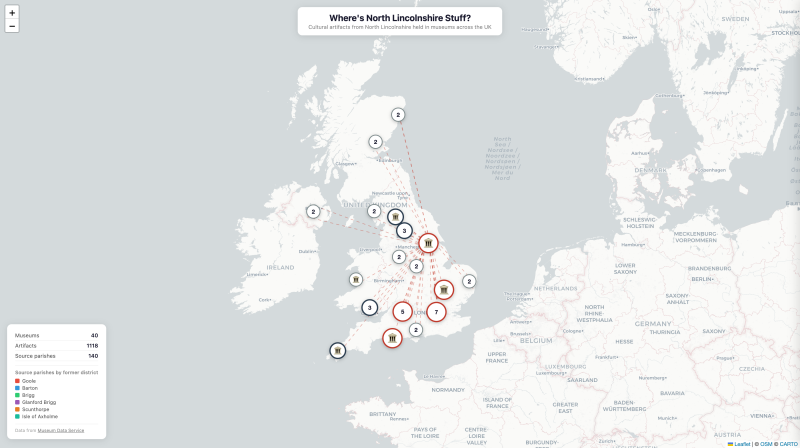
The longer-term ambition goes further. The same approach could power location-based storytelling, tracing where an object has been over the course of its life, opening up new ways for museums to tell richer stories about their collections.
The team also explored an experimental AI layer. This built on a recent community project where members of the North Lincolnshire Sanctuary Group, a volunteer organisation working with asylum seekers and refugees, had written poems in response to objects from the museum’s world collection. The team experimented with AI sentiment analysis of these poems, with the aim of eventually using that emotional response to suggest related objects from the collection. It didn’t get all the way there, but it opened up an interesting line of thinking about how emotional and interpretive data could become a new way of connecting objects across collections.
Rotherham Museums: capturing exhibition knowledge with Glean
The team that took second place, which included Callum, our Senior Designer, tackled Rotherham Museums’ challenge. When curators prepare an exhibition, they build up a huge amount of new research across spreadsheets, Word documents, and PowerPoint files. Around 500 objects were considered for their most recent exhibition ‘Collecting Rotherham’. But when the exhibition closed, almost none of that knowledge was fed back into the collections management system. There just isn’t time to re-enter it all manually.
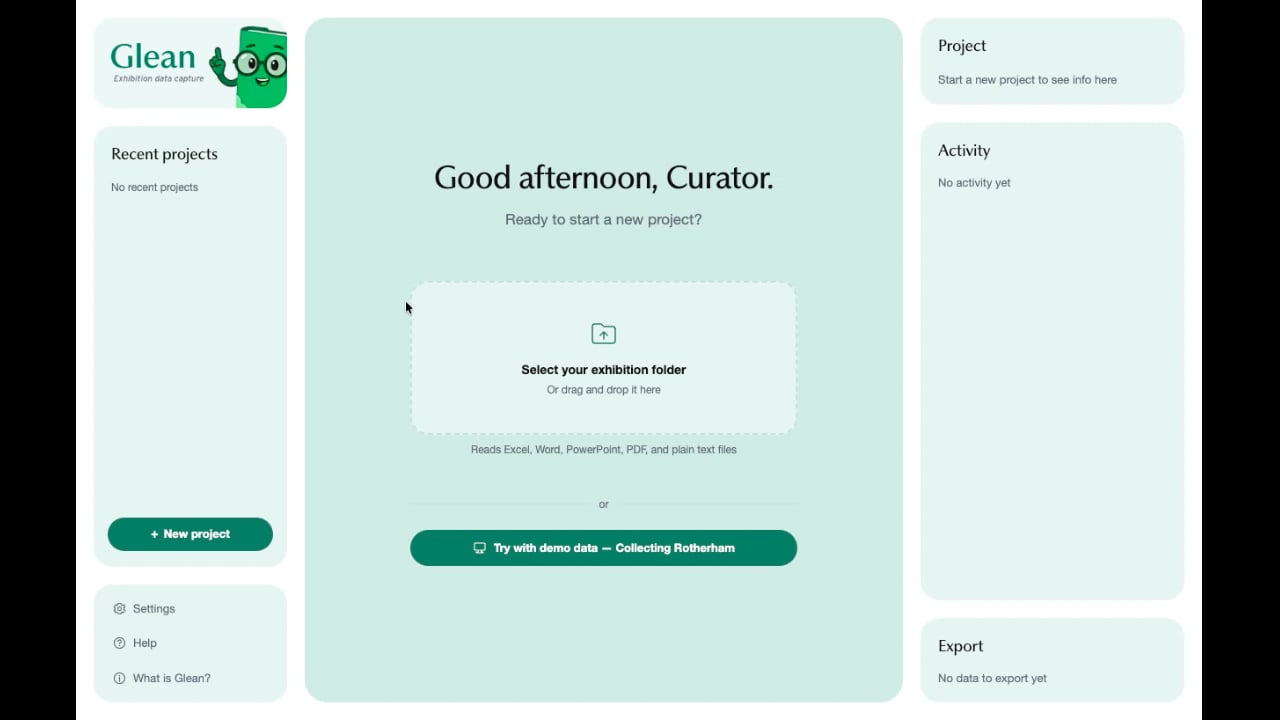
The team prototyped a tool called Glean. Point it at an folder on a local machine containing all the additional information generated during the exhibition planning, and it reads through everything, then shows the curator, in plain English, what it’s found and where it thinks each piece of information belongs in their CMS. The curator approves, edits or dismisses each suggestion. Nothing moves without their say-so. The final output is an import file that slots straight into the museum’s existing workflow.
Having a curator from Rotherham on the team made all the difference. She could spot where the tool's language didn't match how curators actually think. And using Claude Code, the team went from concept to working prototype in under two days.
The bigger picture
Both projects reinforced something we see time and again in the arts and culture sector: the most impactful technology isn’t always the flashiest. It’s the technology that removes friction, saves time for overstretched teams, and makes existing knowledge more useful.
Hackathons like this also show collections teams what’s possible. Museums often work to long timescales, so seeing a working prototype emerge in under two days can shift perspectives and galvanise change. We’re excited to see where both prototypes go next.
If your organisation faces similar challenges around collections data or making better use of the knowledge your teams generate, we would love to hear from you and see how we can help. Get in touch.