

Marketing Lead
With a passion for purpose-driven marketing, Rob leads our marketing team, shaping the strategy behind Numiko's growth.
What we learned at All Day Hey! 2026
What we learned at All Day Hey! 2026

Written by Rob Allen, Marketing Lead
News —
Jump to content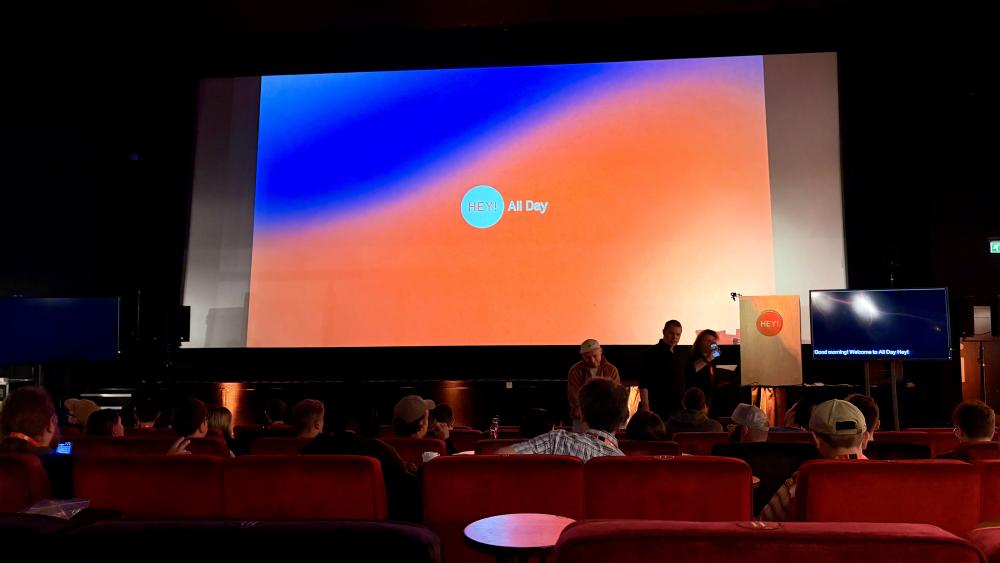
What stood out from a day of talks on accessibility, AI, animation and how teams work.
If you build websites, you'll know how quickly the ground shifts. Browsers gain new capabilities, the tools change, the way people interact with your site evolves. Keeping up with what actually matters, versus what's just noise, takes effort. Conferences like All Day Hey! in Leeds are a good place to do just that.
The day covered a lot of ground: a Google engineer pushing CSS animations into uncharted territory, the Chair of the W3C making a case that accessibility holds the key to agentic AI, a UX designer on why half your team might not be talking, and a live-coded browser game built on audience suggestions.
Bramus Van Damme, a Developer Relations Engineer at Google, showed how Browsers can now handle transitions between page states natively, smoothing animations that used to need external tools and a lot of extra code. His standout demo tied animations to scrolling, so transitions played as you moved down the page, creating this kind of rich, layered visual effect you’d associate with a big-budget marketing site, but built entirely with what the browser already offers.
This matters if you manage a website: a lot of the extra code sites carry for animation and visual effects is becoming unnecessary. Replacing it with native browser features means better performance, fewer things to break, and a smoother experience for the people visiting your site.
This was, for us, one of the most important talks of the day. Léonie Watson is Director of TetraLogical, Chair of the W3C Board of Directors, and she’s blind. She uses a screen reader every day. That combination of deep technical authority and daily lived experience gave her argument real weight.
AI tools are increasingly being built to act on people’s behalf, reading websites, making decisions, carrying out tasks. But a screen reader has been doing something very similar for decades. Léonie’s point was that AI agents break at exactly the same points where screen readers have always broken: wherever a website’s structure is unclear, meaning is simplified rather than spelled out, or the design assumes everyone uses it the same way. If a screen reader struggles with your site, an AI agent will too.
She raised sharp questions about whose needs these tools are actually built around. But the implication is encouraging: if you invest in making your website well-structured and accessible, you’re also making it ready for a future where AI tools interact with it on your audience’s behalf. You don’t have to treat these as separate problems, because they’re the same one.
Fiona Safari, a UX Designer at Tesco, shifted the focus from code to people. Modern work, especially in agencies and design teams, assumes everyone is happy to talk constantly. Workshops, brainstorms, networking back-to-back calls. Fiona’s point was that this format systematically sidelines introverts, people whose energy works differently in social settings. They end up unseen, not because they have nothing to say, but because the format doesn’t give them a way in.
Her advice was practical: prepare before meetings rather than thinking on the spot, use writing to make your contributions visible, build relationships through one-to-ones rather than big rooms, and be deliberate about where you spend your energy.
The sharpest point was aimed at managers: if the loudest people are doing all the talking, you’re only hearing from half your team. Circulating agendas in advance, building solo-think time into workshops and defaulting to written-first communication improve outcomes for everyone. Pre-reads before kick-offs and async follow-ups after workshops are small changes that make a real difference.
Cassie Evans from GreenSock coded a playable browser game from scratch on stage, with the audience shouting suggestions for characters, enemies and mechanics. It went wrong repeatedly, which is exactly what made it fun to watch.
The demo was also a showcase for GSAP, a long-established animation toolkit that became entirely free in April 2025 when Webflow acquired GreenSock. What came through is how capable it is for playful, interactive work, the kind of motion and personality that makes a website feel alive rather than static.
We've been exploring what AI coding tools can do too, if you're curious.
Phil Hawksworth closed the day with 25 years of perspective. Most of the specific technologies he’d invested in over his career are gone or unrecognisable. The things that lasted were habits: curiosity, clear communication, being comfortable not being the expert in the room. He made a strong case for play as a learning mode, that silly side projects with no client and no deadline are often where you stumble on techniques that turn out to matter. That rang true for us. We’ve been designing and building websites for just over 25 years, and the things that have lasted are much the same.
If any of this feels relevant to what you’re working on, get in touch. We’d love to talk it through.
Marketing Lead
With a passion for purpose-driven marketing, Rob leads our marketing team, shaping the strategy behind Numiko's growth.