

Marketing Lead
With a passion for purpose-driven marketing, Rob leads our marketing team, shaping the strategy behind Numiko's growth.
The new rules of search: how to get your content found
The new rules of search: how to get your content found

Written by Rob Allen, Marketing Lead
AI —
Jump to content
Search behaviour is changing rapidly. Here’s how to make sure they still find you.
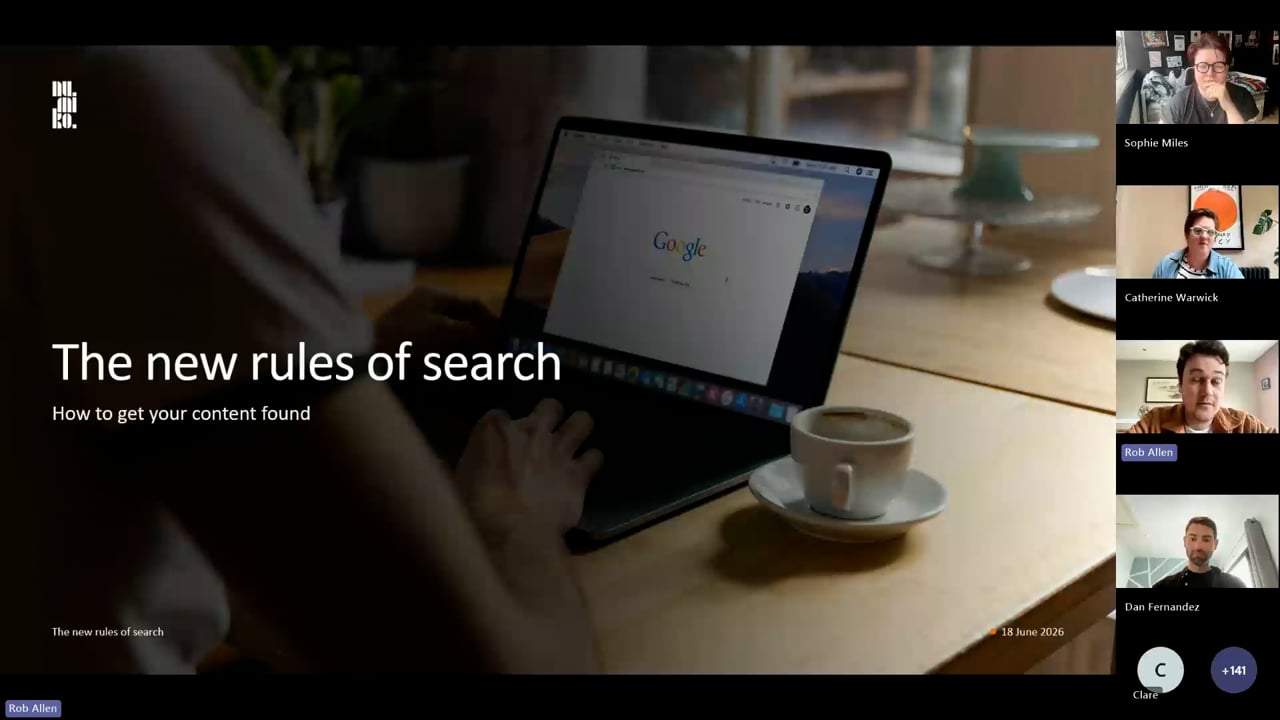
We recently ran a webinar on how to respond to AI search with Sophie Miles, our Lead UX strategist, Dan Fernandez, our Director of Search Strategy, and Catherine Warwick, our Client Partnership Lead. You can watch the full recording here, or read on for the key takeaways.
For two decades, getting found online meant playing by Google’s rules. That’s changed. When someone asks ChatGPT or Claude a question, they often get a direct answer without ever clicking through to a website. Your content might inform that answer, but you won’t know if it’s been used.
For purpose-driven organisations, that matters more than it might for others. If someone asks an AI about cancer treatment, childhood poverty, or what’s on at a museum this weekend, the answer they get shapes what they do next. If your organisation should be the authority on that question and isn’t part of the answer, that could be a problem.
Most organisations come to this problem from the wrong direction. They open their analytics, see what’s performing, and try to optimise from there. The trouble is that most analytics tools were built for e-commerce businesses, not purpose driven organisations.
A much better starting point is to ask: what do we want to be known for? Not in a brand strategy sense, but specifically. What do you uniquely know, hold, or offer?
A university might want to be the go-to source for a particular course area. A charity might produce the most credible research in their field. A museum might be the only place in the world where you can see a specific artist’s work. The more concrete you can get, the more useful the answer.
From there, you can map the searches and prompts that should lead to you. A children’s charity might want to own the answer to “how to recognise child abuse”. A museum might want to show up for “best place to visit in London in half term”. These searches are happening right now. AI is answering them with whatever it can find. The question is whether it’s finding you.
Once you’ve done that thinking, your success measures become much clearer. A museum might want AI to accurately describe its opening times and accessibility information. A charity might want to appear whenever someone asks for recommended organisations in their cause area. These are very different definitions of success, and none of them show up cleanly in a standard SEO dashboard.
Macmillan Cancer Support is a good example of what this looks like in practice. They they’re consistently among the most-cited charity sources in AI responses about cancer and cancer treatment. They haven’t got there through an unusually large budget or clever technical tricks. Their content is just extremely clear, and they have a very specific sense of what they want to be known for.
Their information architecture is built around the stages people actually go through during a cancer diagnosis, not around Macmillan’s internal structure. Their navigation features sections like “worried about cancer” and “treatment and after treatment”, which maps directly to how people search. Pages answer specific questions in plain English right at the top. They close with named accreditation and visible review dates, so people can see the content is trustworthy and current.
AI systems are looking for the path of least resistance to a trustworthy answer. Macmillan has made sure that path goes straight to them.
For organisations publishing long-form or complex content, like policy reports or research, this doesn’t mean restructuring everything into FAQs. Descriptive page titles, technical terms defined where they appear, statistics surfaced clearly, and strong links between related content all help AI understand the depth of your authority on a subject.
Beyond content, there are a few technical things worth getting right. AI platforms don’t return one ranked result like a search engine does. They synthesise from many sources at once. Being found well means being a consistently cited, trusted voice across a range of queries, and that depends partly on how well your site is structured for machines to read.
It’s worth checking whether AI bots can actually navigate your site and make sense of its structure. It’s also worth auditing for outdated content. AI platforms hold what they’ve ingested and don’t automatically refresh it, so an old page describing an exhibition that closed two years ago can still shape what an AI says about your organisation today.
Schema markup can help in specific cases, particularly for events, where structured data around dates, locations, and ticketing feeds directly into how that information appears.
The organisations best placed to benefit from this shift are exactly the ones that we know best: museums, charities, universities, think tanks, public institutions. These are the organisations with genuine expertise, real authority, and content people can trust. The work is making sure people can find it.
We’ve built a service around exactly this called ‘findability’. Most tools will tell you what’s wrong. We tell you what to do about it, in plain English, with a strategist, a technical lead, and a content specialist working through it with you, from understanding what you want to be known for all the way to making the changes that get you there.
If any of this feels familiar, we’d love to talk it through.
Marketing Lead
With a passion for purpose-driven marketing, Rob leads our marketing team, shaping the strategy behind Numiko's growth.