
Our round-up of this year’s talks, workshops and conversations on the realities of AI.
Our latest Great Digital for Good Conference, held on November 11th in London, brought together an exceptional group of digital professionals from universities, museums, charities and the public sector.
This year’s theme was AI realities. People are already using AI to find answers from purpose-driven organisations, but the reality rarely matches the headlines. Across talks, workshops and hands-on exercises, we explored the good, the bad and the ugly of AI in use today.
We've always found that some of the best ideas come out of the conversations between sessions. So we built in plenty of time for people to connect, compare notes and keep talking after the day.
We've summarised each talk and workshop below, to give you a taste of the day.
How will AI change jobs? It's already changed ours
If all you have is a hammer, it's tempting to treat everything as a nail, and AI is a very shiny hammer. Catherine Warwick, Client Partner at Numiko, and Daniel Wilson, Numiko’s Head of Design, shared what a year of working alongside AI has taught them.
Catherine started by handing her admin to Claude and turning meeting transcripts into briefing notes. It worked so well that she found herself lying awake dreaming up new uses for it. That’s when she realised AI amplifies everything, including our urge to overcomplicate. After a break, she changed her approach. Now it does the carrying so she can do the thinking, and before handing anything over, she asks what she'd lose if Claude did it.
Daniel followed with how AI has changed design at Numiko. Concepts that used to be flat designs are now clickable prototypes that clients, and even prospective students can test long before anything is built. He keeps early creative work on an open canvas though, because when AI takes the lead, the results feel generic. A tool is only as good as the person using it, and some jobs still belong to the designer’s hand.
Both agreed that AI has given them more time for the parts of their jobs that matter most. The hard part is deciding what to hand over, and that still takes a human.
Beyond the hype: How public bodies and universities are really using AI
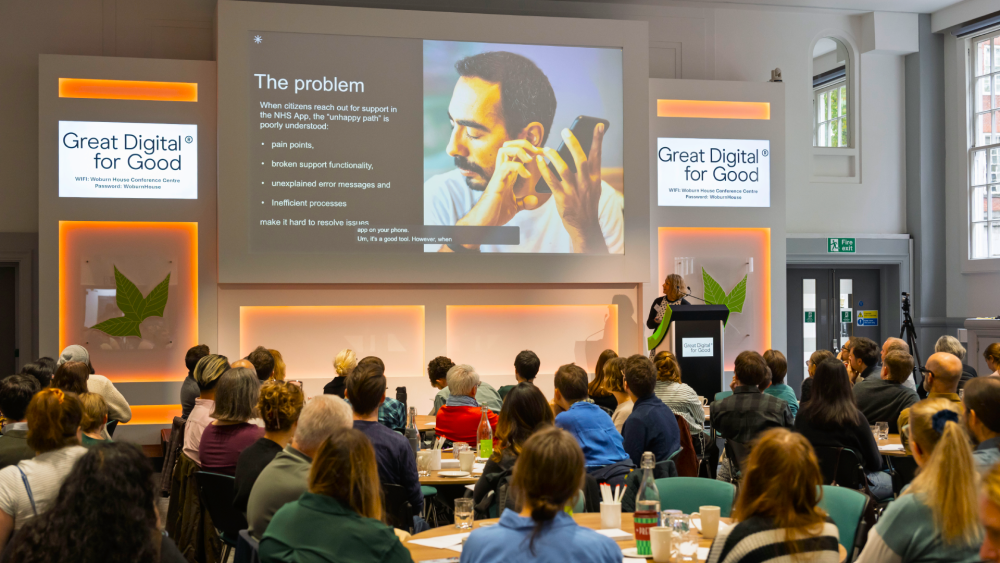
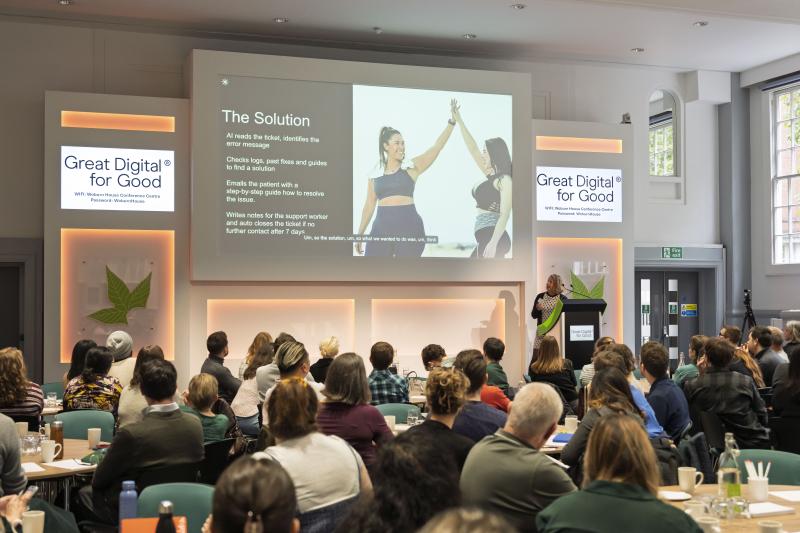
What does AI look like when it’s actually working? Melanie Read, Delivery Director at Valtech, shared three examples of AI already at work in the public sector and higher education. With NHS England, her team has been working to replace the NHS app’s catch-all contact form with an AI tool that understands what’s gone wrong and suggests a fix. On GOV.UK, AI search helps around 14% more people find what they need on the first click. And at the Open University, prospective students can now search tens of thousands of pages in their own words.
She was honest that none of it was quick, with governance on the NHS project alone taking a year. Her advice was to start with the problem rather than the technology, redesign the whole process instead of bolting AI onto an old one, get your data in order, and bring people with you, because adoption is as much about people as technology.
You can view the slides from Melanie's talk here.
Workshop: AI realities
Hackdays provide a space to think big and test out wild ideas that usually would never make it off the drawing board. Jaron Ghani, our Innovation Director, and Paul Costello, Client Partner at Numiko, gave delegates a taste of how a hackday works with a half-hour hackday speedrun.
With AI, you no longer need to code to build a working prototype. The harder skill is finding the right problem. So delegates worked in small, mixed teams, picked a problem their users face and kept digging until they reached the root cause. From there, they brainstormed ideas, then planned a prototype they could test, and thought through how they'd know if it worked.
Our favorite idea of the day, from a team of Oxford University and the British Library, won a free Numiko hackday of their own to bring those ideas to life. We look forward to running that with them in the new year.
If you're planning a hackday of your own, Jaron and Paul suggest thinking big, taking inspiration from outside your sector, and having fun.


AI's hidden workloads
Ash Mann, Independent Strategist and Advisor, has spent much of the past year researching ‘hidden workloads’, running surveys and interviews to dig into this under-discussed issue in the culture and non-profit sector.
His latest report, The Hidden Cost, looks at the digital work everyone relies on but nobody plans for, like firefighting, maintenance and translating between teams. More than a quarter of the digital staff he surveyed spend at least seven hours a week on work nobody planned for, and only 11% feel their organisation understands what their role involves.
Ash took those findings and applied what he’d learnt to the issue of AI adoption.
Decisions about AI projects are often made far from the teams doing the work. Someone still has to test it, make sure that what it produces fits the organisation, manage colleagues’ expectations and clean up when things go wrong. But that work is often invisible to those making the decisions.
Before bringing in the next shiny new tool, Ash’s advice was to map the hidden work you already have, decide who will look after any new tool, involve the people who’ll carry it, and agree what they’ll stop doing to make room.
Collection Dreaming for the National Gallery
What would it look like if an art collection could dream?
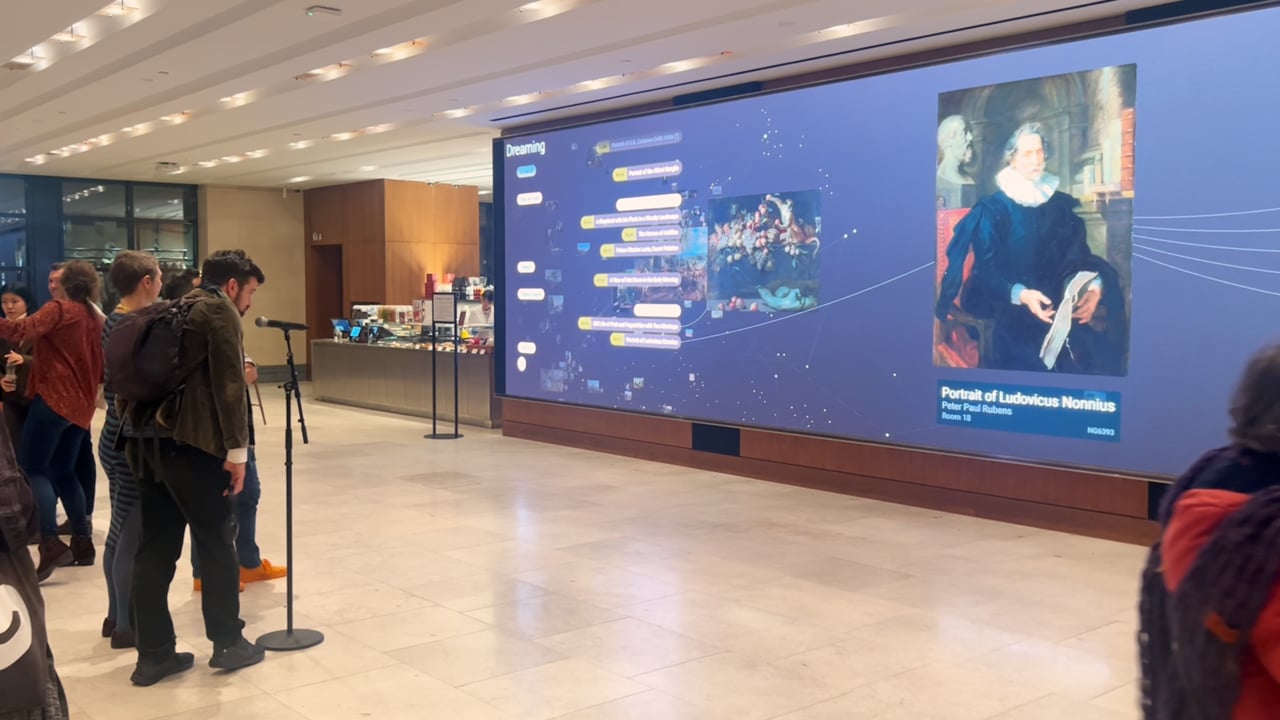
National Gallery Dreaming explores that idea, applying AI creatively to create a unique experience for the National Gallery.
Lawrence Chiles, Head of Digital Services at the National Gallery, and Jaron Ghani, our Innovation Director, shared a year of work on the project, which takes people on a serendipitous journey through around 2,400 paintings.
AI computer vision picks out features like faces, objects and shapes, then combines them with the gallery’s own records to find connections between works. The journey follows those links from painting to painting, explaining its reasoning as it goes, and visitors can steer it by speaking.
Rather than replacing years of curatorial expertise, Dreaming does something totally orthogonal to it, producing a totally different experience that doesn’t seek to replace the human.
Why design still matters, even in an "AI first" world
Back In 2010, Numiko declared “this is the year of 3D”, and even printed a newspaper with a pair of 3D glasses inside. As Callum Badger, our Lead Designer, put it, we’ve been wrong about technology before.
Callum didn’t pretend to know the future of AI. But he did map out a vision for how great design and UX expertise will retain its essential role even as digital experiences are revolutionised by AI.
He suggested asking three questions of everything on your site: Is it designed to be trusted? Is it designed to be experienced? Is it designed for the task? If the answer is yes, then the answer is probably not going to be adding a chatbot interface. Delivering users what they need starts by understanding those needs, and that might, in some cases, mean adding AI tools, but it equally might mean a clearer information architecture, a simpler form, or more imaginative way of displaying the information.
View the slides from Callum's talk here.


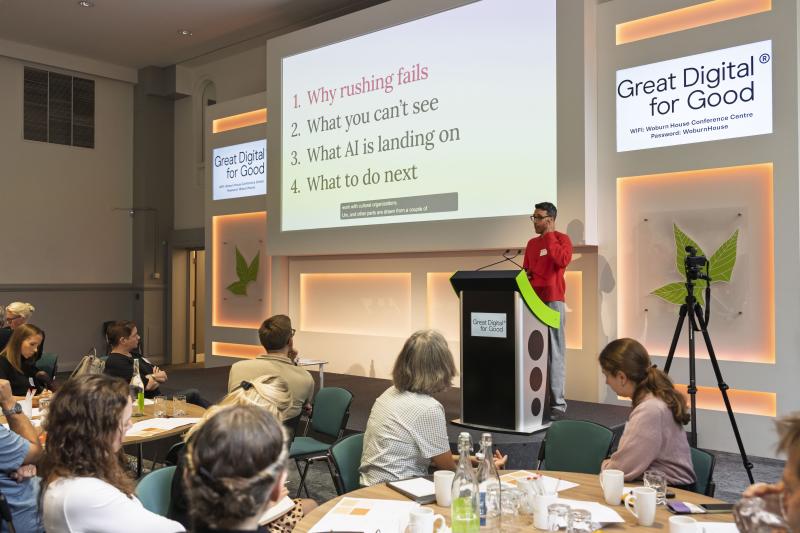
Hardening your website in a world of AI-powered cyber threats
Andy Whale, our Head of Back-End Development, and Josh Hayter, Lead Back-End Developer, talked us through what the surge in cyber attacks means for organisations that we work with.
They explained that most cyber attacks are the digital equivalent of someone checking for an unlocked door. AI can check millions at once, so it’s finding a whole lot more. But having the right protections in place can still keep your site safe.
This talk was made more relevant by events just a few weeks before. On 21 October, a 14-year-old critical flaw in PHP, the language behind around 70% of websites, was uncovered with the help of AI and made the national news. In his part of the talk, Andy mapped out our response. Our team had clients briefed by lunchtime, kept them informed throughout and had every site safely back online that night.
Josh then talked through what you can do to keep your website safe: Turn on multi-factor authentication everywhere, patch critical issues within days, and have a tested plan ready before you need it.
What a hackday unlocked
James Moore, Head of Digital at the University of London, shared what happened after he and Bethany Brown, Associate Head of Web at the NSPCC, won a Numiko hackday at last year’s Great Digital for Good. The idea was an AI platform that would pull together data from different tools and turn it into actions.
The prototype was only the start. At the University of London, the team realised they already had more data than they could use, so they cancelled tools that weren’t good value and saved money. At the NSPCC, a dashboard built on the day prompted a rethink of who does what, freeing Bethany’s team to focus on content strategy. Their advice was not to judge a hackday by its prototype alone, because the most valuable outcomes often come afterwards.
Bringing the Bayeux Tapestry to life online
Alison Bean, Website Product Manager at the British Museum, took us behind the scenes of the online Bayeux Tapestry experience that Numiko helped them to build. Alison called it a once-in-a-lifetime project, and it’s now also award-winning, with the project picking up a Gold LOVIE award, as well as the people’s choice award a few days before.
There’s a lot to explore, and people settle in for long stretches and keep coming back for another look, especially to the beginning and end. Alison’s theory: people want to see the gory bits.
She was glad the team made it fully accessible from launch, wrote it so 7 to 11 year olds could follow it, and built it as a template the museum can reuse for other objects. Her main lesson was simple: if you want people to use a feature, don't hide it away in a menu.
You can interact with the experience for yourself here and view the slides from Alison's talk here.
SEO strategy: in search of simplicity
James Dodd, Head of Digital at Royal Holloway, explained how an SEO strategy finally made it off the long to-do list. It had always felt too big, and the university seemed to be doing fine without one. The breakthrough was keeping it simple: start with the data, focus on one goal (helping prospective students find the university through organic search), and be clear about what's out of scope, including AI optimisation and the website as a whole.
The resulting strategy focuses on courses, accommodation and campus life, helping keep the scope under-control, with a phased-roll out and an annual review to keep it on track.
You can view the slides from James' talk here.


Summary
If you’d told us a whole day of AI talks could feel refreshing, we might not have believed you.
But our speakers kept things real, sharing honest, practical stories about where AI helps, where it doesn’t, and where people still need to lead. This was, for once, a hype-free zone.
Our favorite metaphor from the day has to be Callum Badger’s, comparing AI to a microwave.
Microwaves are great at what they do, and when they first came out people thought they were the future of cooking. Now we've all got a microwave, but we don't make our roast potatoes in it.
We can’t wait to do it all again next year, so if you’d like to speak or get involved, do get in touch as we’ll be putting together next year’s agenda together before we know it.